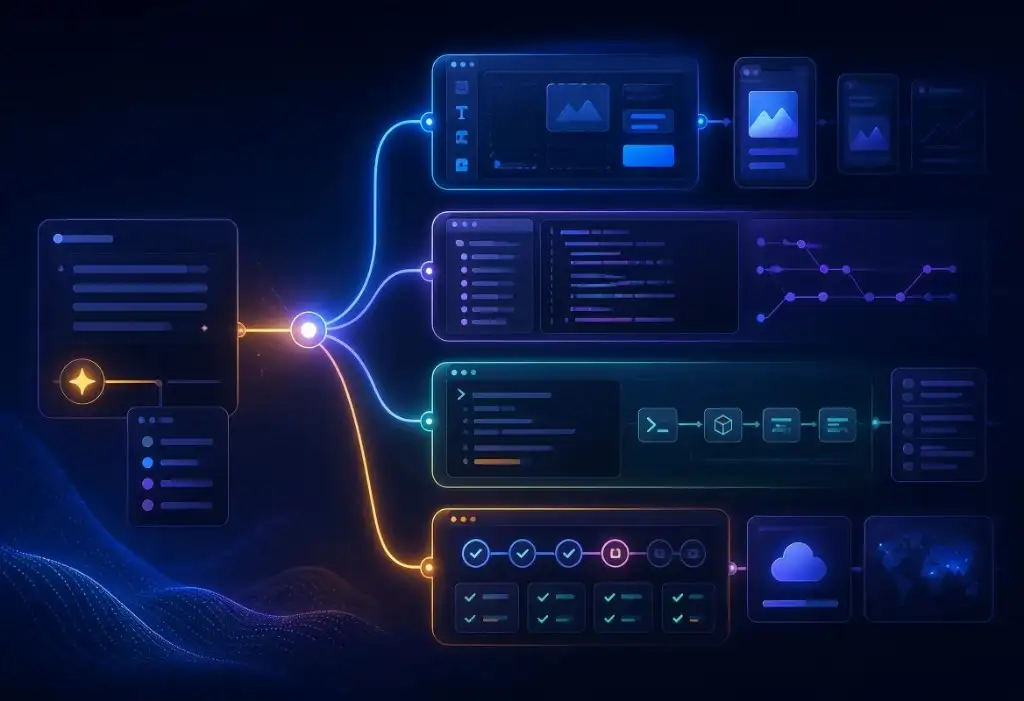


Vibe coding means building software by describing what you want in natural language, then using an AI coding tool to generate, revise, and extend the code. Instead of starting with every technical detail, a founder, product manager, designer, or developer can explain the desired outcome and let the AI create a first working version.
Andrej Karpathy coined the term in February 2025 to describe an AI-first, conversational way of building software with minimal manual coding. By mid 2025 authors and community discussion were treating it as a recognizable developer meme and practice, with debate over whether it is a novelty or a real workflow shift. In 2026 it is now the primary term for this new way to create software for startups and non-technical builders.
What vibe coding means
At its simplest, vibe coding is prompt-driven software development. The builder focuses on the vibe of the product: what it should do, how it should feel, and what the user should experience. The AI coding assistant handles much of the implementation work, generating the code behind the screens and workflows.
Vibe coding can make the distance between idea and prototype much shorter. A team can describe a login screen, dashboard, booking flow, payment step, or internal workflow and quickly see something they can click, test, and improve.
Tools like Lovable, Claude Code, Replit, Base44 and Bolt.new have made this approach more accessible by providing managed platforms where users can prompt, preview, and publish quickly. By contrast, other tools like Cursor and GitHub Copilot generate code within a more traditional development environment. At their simplest these platforms can create entire applications by giving a single prompt.
Vibe coding is not just an autocomplete feature. It is a more conversational way of shaping software, where the builder repeatedly prompts, reviews the result, asks for changes, and keeps moving.
Why vibe coding is useful
Vibe coding works especially well when the goal is learning. If you are trying to validate a product idea, test a user flow, create a proof of concept, or show investors what you mean, a vibe-coded prototype can be extremely valuable.
It helps teams answer practical questions sooner:
- Does this workflow make sense to users?
- Is the core idea understandable?
- What features matter most?
- Where does the product feel confusing?
- Is this worth turning into a full MVP?
For early-stage work, speed is the advantage. You do not always need a fully engineered platform to learn whether an idea has potential. Sometimes you need a realistic prototype that helps people react to the product instead of imagining it from a document.
Where vibe coding gets risky and what to do next
Where vibe coding gets risky
Vibe coding becomes risky when a fast prototype is treated as if it is already production-ready. AI-generated apps can look polished while still having weak authentication, unclear data rules, missing tests, fragile architecture, or security issues that are hard to see from the interface.
That does not make vibe coding bad. It means the product has moved into a different stage. Once real customers, payments, private data, or business operations depend on the app, the code needs deeper review.
This is where teams often hit the Vibe Coding Wall: every new prompt makes one thing better but accidentally breaks something else. The product still has momentum, but the codebase needs structure, cleanup, and guardrails.
How Future Wonder thinks about vibe coding
At Future Wonder, we see vibe coding as a powerful starting point. It can help founders move faster, clarify requirements, and test ideas earlier. But the best results come when AI-assisted speed is paired with experienced product, design, and engineering review.
A healthy path usually looks like this:
- Use vibe coding to explore the idea and validate the core workflow.
- Turn the working prototype into clearer product requirements.
- Review the codebase for security, architecture, data handling, and maintainability.
- Add tests, deployment structure, and a repeatable release process.
- Builders keep vibe coding using human and AI assisted review and release process.
If you already have a vibe-coded prototype and want to know whether it can become a real product, Future Wonder can help with a Vibe Code Rescue. We review what you have, identify what is worth keeping, and help turn a fast prototype into software that can support real users. You can keep vibe coding features and they flow through a robust software development process that we have added.
Vibe coding is not a shortcut around good software practices. It is a faster way to reach the point where those practices matter.